

In Soa Village, Tanah Miring District, Merauke Regency, cashew trees were first planted in 1999, with the hope of creating a new source of income for local communities. However, for nearly three decades, this potential remained largely untapped. Farmers continued to sell their cashews raw to middlemen, with limited opportunities to process the harvest or increase its value. Without access to processing knowledge and training, farmers had little say in setting the selling price, which was largely determined by buyers.
“Before I joined the cashew processing training, I felt like it was difficult and that my options were limited. I had never thought about processing cashews. It turns out we can roast them, make salted cashews, chocolate cashews, and even cashew milk,” recalls Mama Antonia, a member of the Jambujob Group, a women’s cashew-processing group in Soa Village.
The situation began to shift in 2023, when Yayasan Dahetok Milah Lestari (YDML) started supporting women in Soa Village. This work grew into a collaboration with Kopernik in 2025, focusing on processing training, capacity building, and the construction of a production house to support local cashew processing.
Kopernik and Yayasan Dahetok Milah Lestari Collaboration
YDML is an organisation based in Merauke, South Papua, with programmes covering Merauke, Boven Digoel, Mappi, and Asmat. Its work focuses on four key areas: environmental conservation, local food security, the protection of Indigenous peoples’ rights, and economic development for Indigenous communities.
In 2025, Kopernik partnered with Yayasan Dahetok Milah Lestari through the “From Forest to Market” programme. The programme seeks to utilise non-timber forest products as a more sustainable source of income, with cashews in Soa Village identified as one of the key commodities to be developed together with Kopernik. Beyond supporting women’s groups in processing cashews into value-added products, Kopernik and Yayasan Dahetok Milah Lestari also provide various training programmes to strengthen the women’s leadership, agency, and resilience in managing their businesses.
“Cashews, or cashew trees, were planted as part of a government programme in 1999. But for nearly three decades, there had never been any training to build the community’s capacity to manage and process cashews,” Andres Sirhalawan, Director of YDML explained “That is what encouraged us to provide training, so that cashews that were previously sold raw directly to middlemen could instead be processed locally.”
In early 2026, YDML and Kopernik held their first two-day training on processing cashews.. The training resulted in eight varieties of cashew products, including original, salted, chilli, chocolate, and cashew milk. From there, the women of Soa Village began moving away from selling raw cashews and started processing them themselves.
Building a Production House: From the Village Hall to a More Suitable Space
Developing new skills did not immediately make things easy for the women. Until then, they had been producing cashews by borrowing the village hall (balai kampung), a space that was not designed for food production and had to be shared with other community activities.
“The first challenge was that we didn’t have a production house. We used to borrow the village hall, and that was very difficult,” said Klara Berenun, Chair of the Jambujob Group.
To address this, Kopernik and YDML built a cashew production house in Soa Village. Construction took place from February to April 2026, and the facility was officially inaugurated on 12 May 2026, with a blessing ceremony led by a local priest.
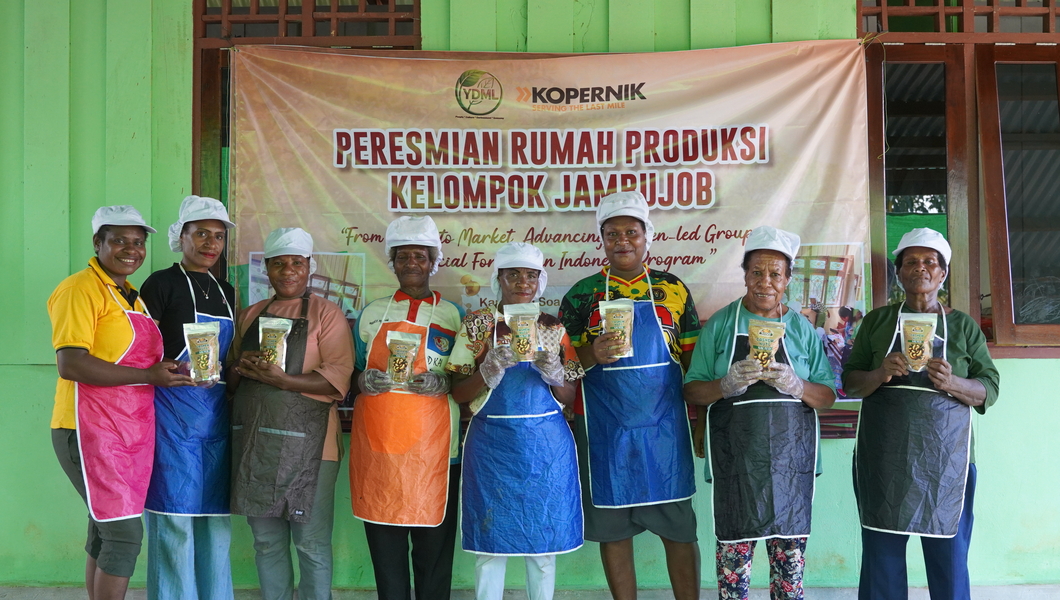
The Jambujob Group during the inauguration of the Production House in Soa Village, Merauke
“After we got the production house, I felt that everything became much easier for us. As the group leader, I feel that it has also become easier for me to bring all the women together,” Klara said.
Coinciding with the inauguration, the group also produced three varieties that had shown the strongest market demand and were selected for continued production: original, salted, and chocolate cashews.
Training That Builds Confidence
For Mama Antonia, the most meaningful change was not only learning new skills, but also seeing herself differently.
“After joining the training, I felt happy. I can make this, I can make cakes, I can make this and that… I thought, ‘If only I had joined the training before, things wouldn’t have felt so difficult.’ We used to think that we couldn’t do things. But now, because I’ve had the training, I feel happier and more motivated,” she said.
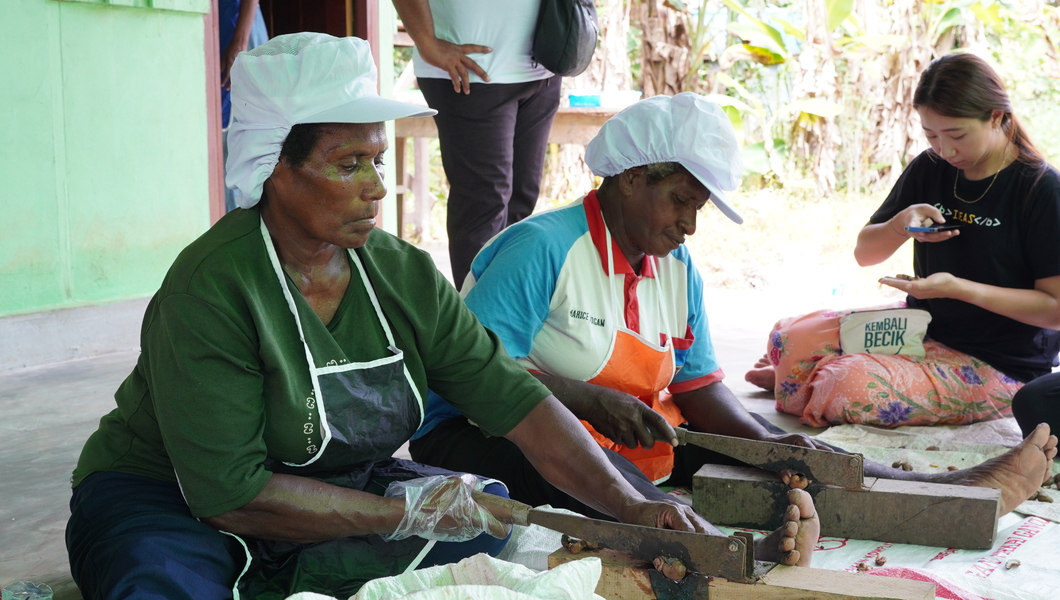
Mama Antonia (centre) and other members of the Jambujob Group peeling cashews for processing at the Production House in Soa Village, Merauke
She has also started making other foods beyond cashews, including doughnuts that sold out in a single day and generated IDR 250,000 in sales.
“Now I can make products from cashews, doughnuts, banana chips, banana cheese… It makes me feel motivated. I’m also very happy to meet my friends and the mentors who come from the city.”
The training provided by YDML and Kopernik goes beyond cooking techniques. It consists of three layers of capacity building delivered progressively: standard operating procedures for managing the production house, proper product quality standards, and leadership training for the women who drive the group forward.
“I believe that with the leadership training, and later the financial literacy training, the women will be able to continue growing and developing,” said Andres.
Looking Beyond Cashews
For Andres, what the women of Soa Village have achieved is tangible evidence of a capacity that had long existed but had not been given enough space to grow.
“From my perspective, when I look at the women in this village, they are truly remarkable. Their development and skills are, I believe, beyond question,” he said.
According to him, the story does not end with cashews. Soa Village is home to many other resources that have yet to be fully developed and could potentially become new products made in the same production house.
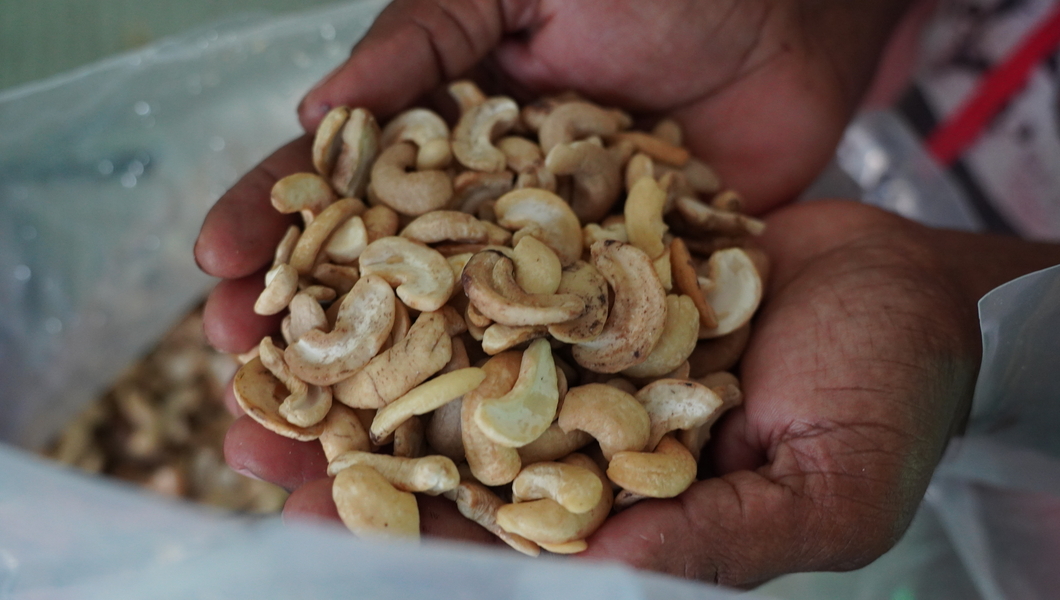
Cashews that have been shelled and are ready for further processing
“We hope that what is produced here will not only be cashews, but also other products from the many resources available, such as lemongrass and bananas. We can make all kinds of products—chips, for example, or even banana flour,” he said.
Klara Berenun shares the same vision. The group has already agreed to begin producing banana flour after establishing a steady cashew production process.
“It is time for women to also become income earners for their families,” Andres continued, “because they can identify the potential around them, process it into something of value, and turn it into income that can support their families today and in the future.”
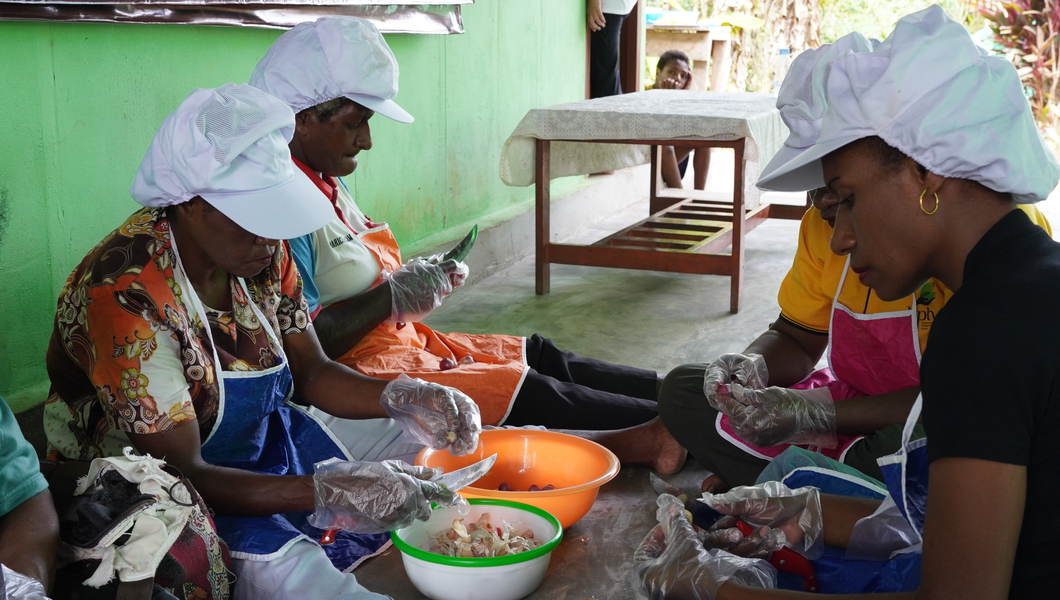
Members of the Jambujob Group preparing ingredients for cashew production at the Production House in Soa Village, Merauke
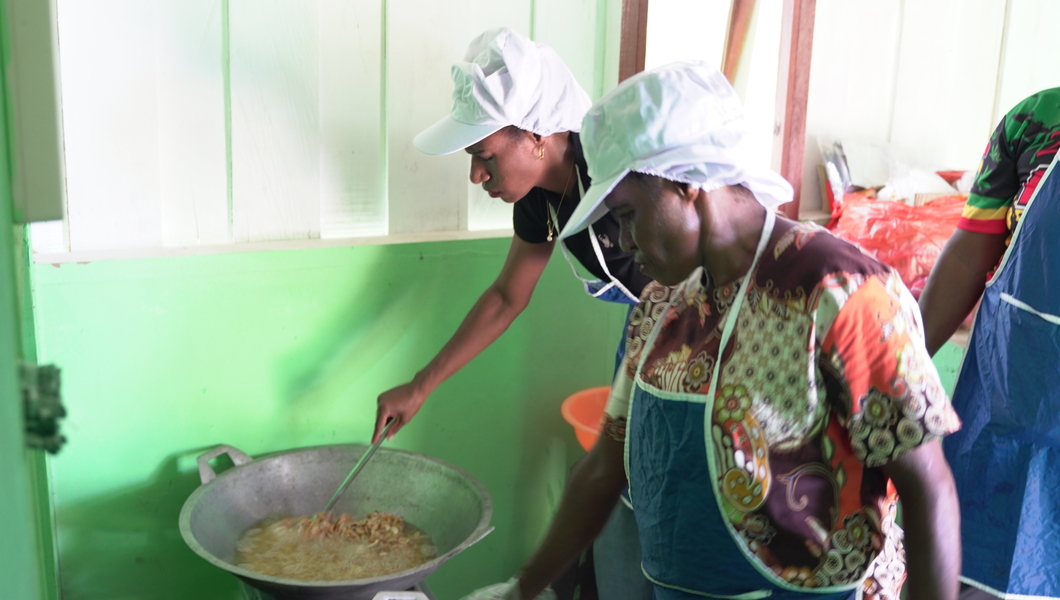
Members of the Jambujob Group frying cashews at the Production House in Soa Village, Merauke
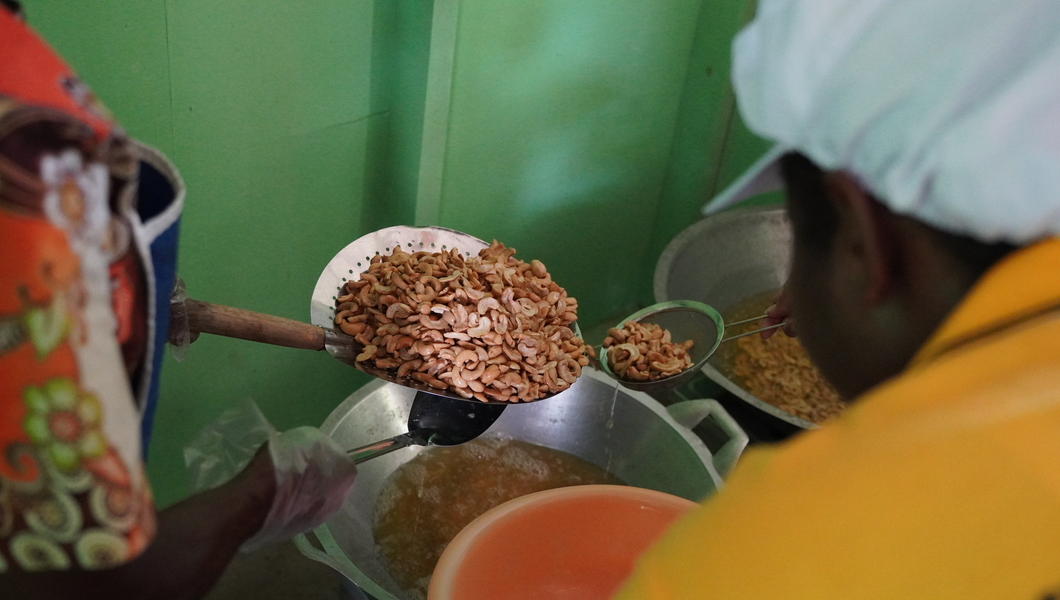
Members of the Jambujob Group frying cashews at the Production House in Soa Village, Merauke
The story from Soa Village is one of many examples of what can happen when women living around forests are given the space, skills, and appropriate infrastructure to grow. Non-timber forest products can move beyond being low-value raw commodities to becoming sustainable sources of livelihood, while strengthening women’s roles as drivers of household economies and stewards of the forests around them.
This initiative is part of Kopernik and Yayasan Dahetok Milah Lestari’s collaboration through the “From Forest to Market” initiative in Soa Village, Kurik District, Merauke Regency, South Papua.
