

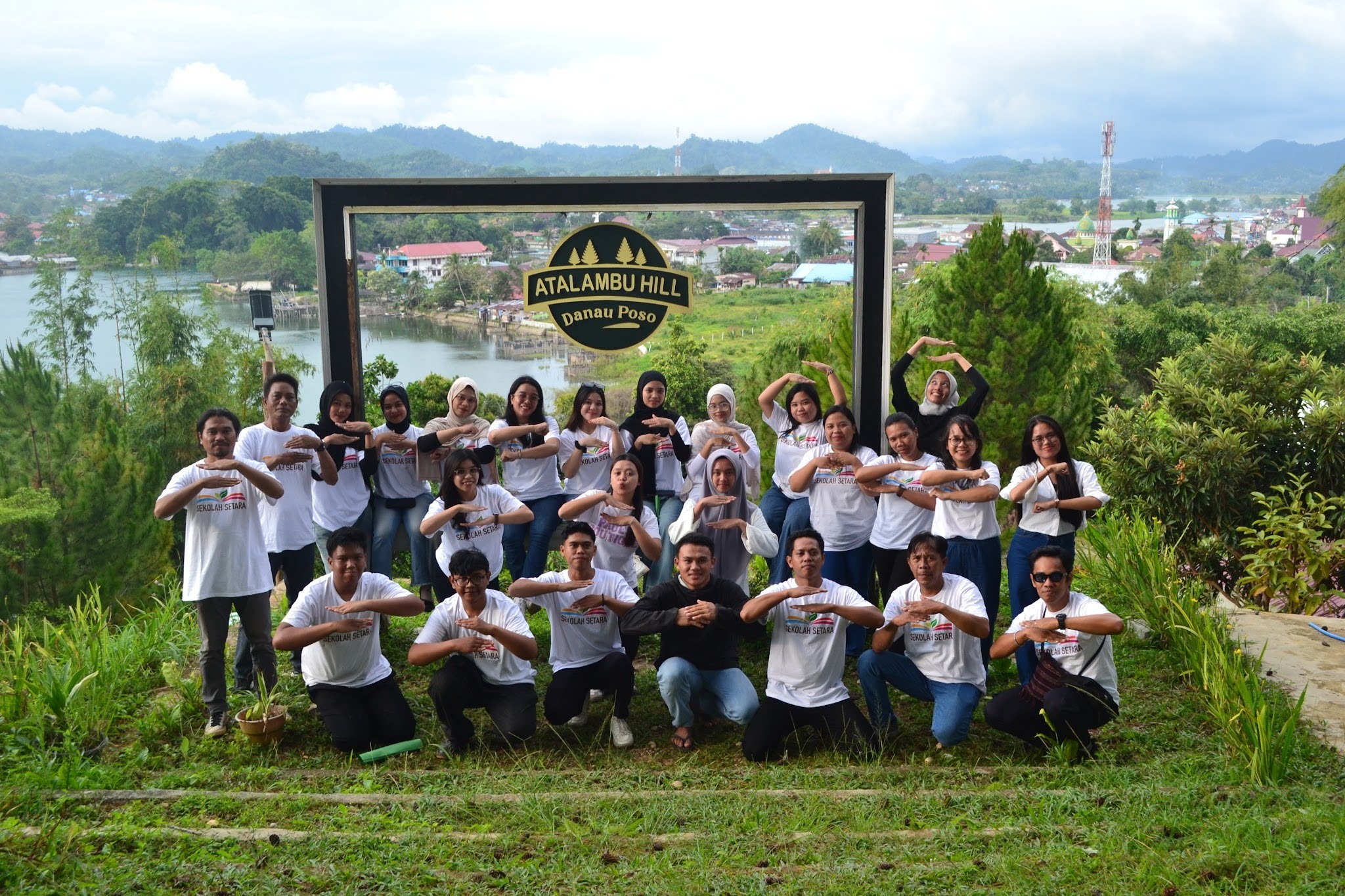
There is one moment that Dwi Preti Natalia Tara'u, better known as Yenni, a 2024 member of Komunitas Setara under Generasi Setara (GenSet)—Kopernik's initiative to challenge traditional gender norms and advance gender equality—will never forget.
During a gathering in Tentena, Poso, Central Sulawesi, young people from Buyukatedo Hamlet and Mayakeli Village—two communities that had long carried narratives of mutual distrust—sat together in the same group. They laughed together. They worked on activities together. For the first time, there were no invisible barriers between them. For Yenni, that moment answered a question she had carried with her for a long time.
A Concern Rooted in Reality
Yenni is a lecturer at Tentena Christian University, Poso, Central Sulawesi, who has long been engaged with issues of gender equality and post-conflict peacebuilding.
One day, she participated in a small community survey on gender inequality. The findings were striking. Women and men worked side by side as farmers, doing the same tasks, yet women were paid less. Men rarely took part in household chores—not because they refused to, but because they believed they were "not skilled" at them. Women were widely seen as naturally weak, while men were expected to be strong, simply because "that's how things have always been."
The experience deepened her conviction that young people in rural communities needed a space to explore gender equality—not through lectures, but through conversations that encouraged them to think critically and reflect on their own experiences.
Finding the Right Opportunity Through GenSet
Toward the end of 2024, an open call appeared on Yenni's Instagram feed.
GenSet is a Kopernik initiative that brings together young people from across Indonesia to champion gender equality and inclusion. Selected participants become members of Komunitas Setara, a safe and collaborative community where young changemakers exchange ideas, support one another, and advocate for gender equality. Members are also invited to submit proposals for community-based initiatives, with selected projects receiving support from Kopernik for implementation.
Yenni immediately felt the programme had been created for someone like her.
After being selected, she joined an intensive five-day workshop in Bali alongside academics, practitioners, and gender experts. One reflection stayed with her more than anything else: communities do not lose members simply because people leave—they lose them when people's voices are never truly heard.

Yenni and fellow Komunitas Setara members during the workshop in Ubud, Bali
She returned home carrying that lesson with her. Together with close friends and her university students, she developed a proposal for GenSet's small grants programme. The proposal was selected for support, laying the foundation for what would become Sekolah Setara (School of Equality).
From the Classroom to Building Bridges Across Communities

One of Sekolah Setara's activities bringing together young people from Buyukatedo Hamlet and Mayakeli Village
The name Sekolah Setara was chosen intentionally. "We wanted to change how young people think about school—not as a place where you simply sit and listen, but as a space for active reflection, participation, and enjoyment," Yenni explained.
The programme focused on two groups of young people who had grown up separated from one another: teenagers from Buyukatedo Hamlet, mostly Muslim, and those from Mayakeli Village, mostly Christian. Both communities continue to live with the lingering memories of the Poso conflict.
Rather than beginning with lessons, the Sekolah Setara team first met with village leaders and prospective participants simply to listen—to understand what they already knew and what they did not. The conversations quickly revealed that even basic concepts such as "inclusion" were unfamiliar to many participants. As a result, the team redesigned the entire curriculum from the ground up. "We didn't simply adopt GenSet's four core themes. Instead, we designed our own curriculum based on what we learned directly from conversations in the villages," Yenni said.
The journey was not always easy. Buyukatedo Hamlet is about an hour and a half from Yenni's home by motorcycle, along steep roads where rain accompanied nearly every session. The team travelled together each time, always carrying raincoats. "Those journeys actually brought us closer together," Yenni recalled with a smile.
Inside the classroom, something even more meaningful began to happen. Participants started asking difficult questions. "Why do campaigns on gender-based violence rarely acknowledge men as victims?" Another participant asked, "Even though Poso's Regent is a woman, why has our own village never had a female leader?" They were no longer simply receiving information—they were questioning, analysing, and reflecting.
Then came the moment Yenni had imagined for so long. Young people from two communities that had grown up apart sat side by side, laughing and learning together. "That was when I knew spaces like this were truly needed," she said.

Another activity bringing together young people from Buyukatedo Hamlet and Mayakeli Village
A School That Continues Beyond the Grant
When GenSet's funding period ended in June 2026, Yenni and her team decided that Sekolah Setara would not end with it.

Members of Sekolah Setara from Buyukatedo Hamlet and Mayakeli Village
Today, the initiative has expanded beyond gender equality to address broader issues of equality in education, access to opportunities, and social status. Youth groups from local churches have invited the team to facilitate discussions on child marriage, and Yenni envisions Sekolah Setara evolving into a platform that equips young people with the knowledge and confidence to become changemakers in their own communities.
For Kopernik, Sekolah Setara reflects what we believe about lasting impact: meaningful change is not something that is imposed from the outside, but something that grows from within communities themselves. When an initiative continues independently beyond its original funding, builds new partnerships, and inspires others to create similar efforts, it is a sign that its impact has truly taken root.
For young people who dream of starting similar initiatives but feel they are not yet ready, Yenni offers one piece of advice: "Start by daring to dream. Dreams have a way of finding their own path—as long as we prepare ourselves to seize the opportunity when it comes."
