

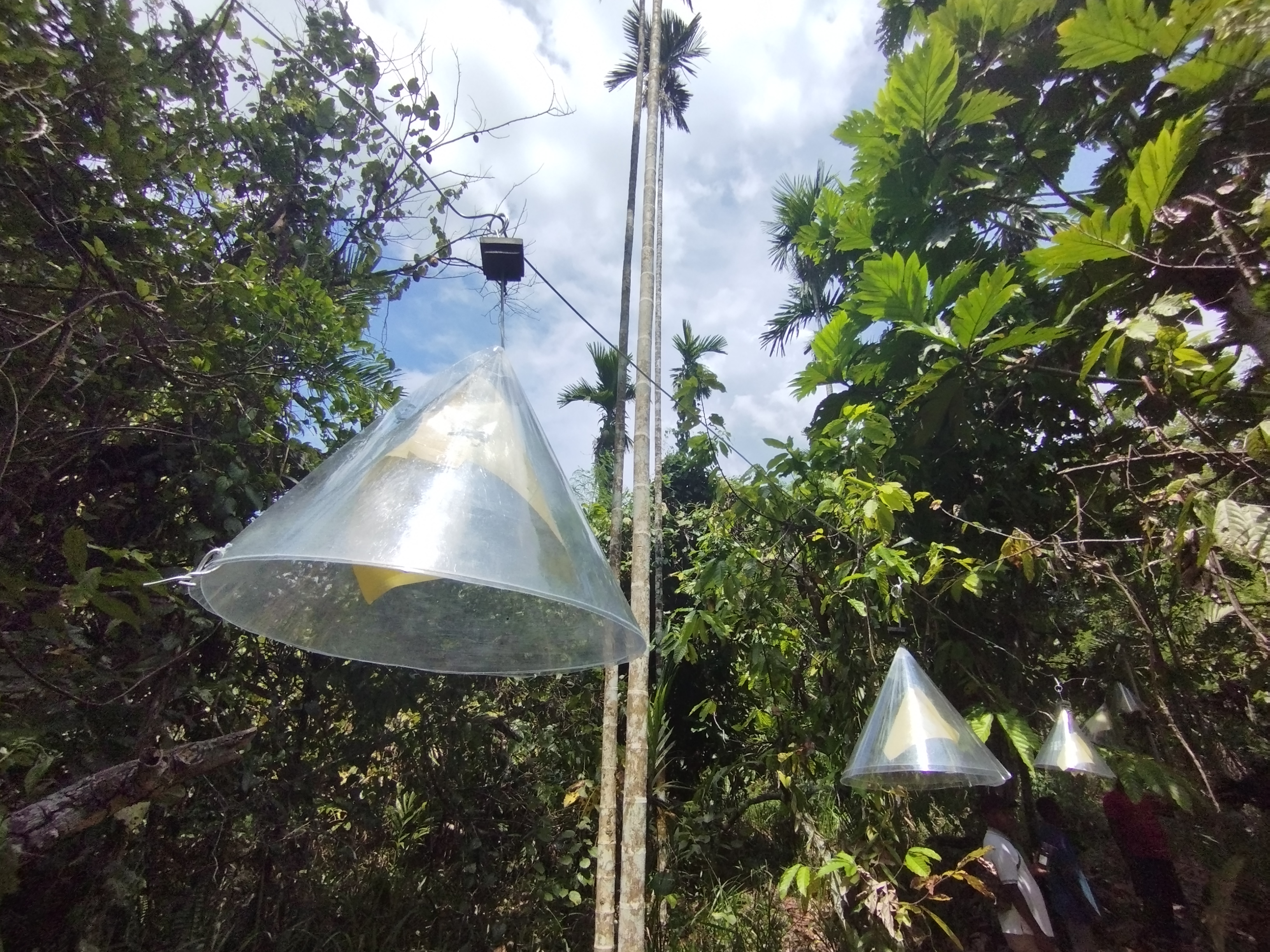
We are testing DIY lure-based traps designed to reduce cacao pod borer (CPB) infestation rates in cacao pods.
Project Type
- Test Potential Solutions
THE PROBLEM
Cacao farmers in Klaisu Village, Jayapura, face significant challenges from cacao pod borers (CPB), a persistent pest that damages cacao pods and reduces crop yields. CPB infestations are particularly severe during key harvest periods, resulting in substantial economic losses for farmers. The larvae bore into cacao pods, causing premature ripening, bean damage, and reduced cacao quality, which directly affects farmers’ incomes and threatens the sustainability of their livelihoods.
Current pest management strategies, including the use of chemical pesticides, are often costly, environmentally harmful, and only partially effective in controlling CPB infestations. In addition, labour-intensive practices such as pruning and field sanitation do not adequately address the underlying causes of the infestation, leaving farmers with limited access to effective and sustainable pest management solutions.
THE SOLUTION
To address this challenge, we propose designing and testing DIY lure-based traps to control CPB infestations using lychee and green coffee bean extracts as organic, locally sourced attractants.
The traps will be monitored to evaluate their effectiveness in reducing CPB populations, improving pod quality, and increasing overall cacao yields across multiple harvest cycles. Key outcome indicators include a measurable reduction in CPB infestation rates compared with untreated control plots, improvements in the quality and quantity of harvested cacao pods, and positive feedback from farmers regarding the traps’ affordability, ease of use, and practicality.
Similar approaches using chemical-based lures have previously been tested, but initial results have not been sufficiently promising. Our proposed solution is based on the hypothesis that organic-based lures may mimic natural fruit volatiles or pheromone-like cues more effectively, thereby attracting CPB more successfully than the chemical lures tested to date.
The project will provide local cacao farmers with a cost-effective and sustainable solution for managing cacao pod borer (CPB) infestations through the use of DIY traps equipped with locally available lures, such as lychee and green coffee bean extracts. The intervention is expected to reduce pod damage, improve cacao yields, and increase farmers’ incomes while promoting environmentally friendly pest management practices.
The traps’ simple and low-cost design will enable farmers to easily replicate, adopt, and share the technology within their communities, encouraging peer-to-peer knowledge transfer and supporting the scaling of the solution to other cacao-growing areas facing similar CPB challenges.
THE PROJECT RESULT
The experiment found that green coffee bean delta traps (T2) were the most effective method for controlling cacao pod borer (CPB), reducing infestation rates by 87% and eliminating detectable CPB presence by the third harvest cycle. Lychee delta traps (T3) also demonstrated strong performance, reducing infestation by 69%, while pruning and sanitation alone (T1) had the lowest impact. In addition, T2 produced the highest average yield of healthy cacao beans per tree, at 0.396 kg.
The economic analysis showed that T2 generated the highest estimated revenue and net profit, representing a 3.6-fold increase compared with pruning and sanitation alone. Farmers reported that the delta traps required minimal labour once installed, making them a practical and potentially sustainable alternative to chemical pesticides.
Nevertheless, further research is needed to optimize lure composition, confirm the identity of the target insect species, and validate the effectiveness of the traps under broader field conditions, thereby supporting more targeted and reliable CPB management.
This project is implemented by Yayasan Kopernik on behalf of our partner who provided grant funding for this project.
