

Dusun Teguhan, nestled in the hills of Gunungkidul, is home to three elderly women who collectively manage a small farm. By 7am, one of them had already swept the yard, put rice on the stove, fed the chickens, and made her way to the pond to feed the catfish. The fish rise to the surface as she approaches; having learned the rhythm of her footsteps. Above the pond, a row of netpots holds water spinach now two weeks into its third growing cycle.
Mbah Jumiyem is one of three women in their seventies in this village who maintain the aquaponic system – a small fish pond and vegetable growing setup installed as part of a Kopernik pilot. Two of them, including her, live alone, and have kept their own households for many years. Together, they manage a small farm, keep chickens and goats for emergency savings, and attend each other's important events. In many ways, they form one of the village's steady rhythms. These are women who have held their lives together with quiet competence for longer than most of us have been alive.
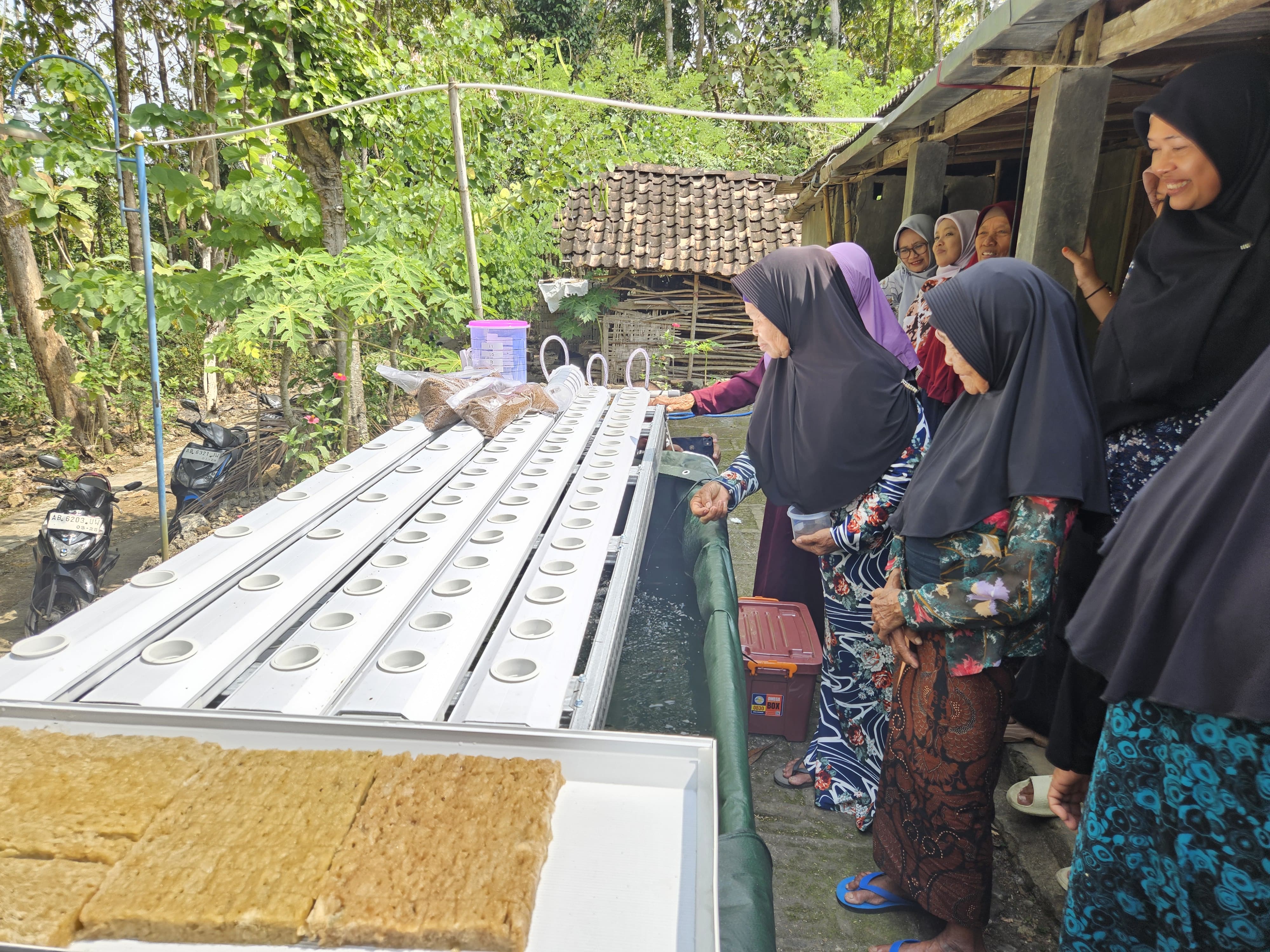
One of the women feeding the fish after the aquaponic usage workshop
In 2025, Kopernik developed and tested an accessible aquaponic system for the elderly. The prototype development started with user interviews, anthropometric measurements, prototype iterations, and a workshop. Six older community members in Gunung Kidul were first interviewed to map their daily activities and pain points. Then, three were chosen as host households, where in-depth interviews and anthropometric measurements ensured that heights and reach distances matched their individual ranges of motion, making the system easy and safe to operate. Daily schedules and supporting tools, such as measuring cups and a feed calculator, were co-developed with them and a support group to produce a clear maintenance procedure.
The aquaponic system installed nearby has become a hub in the women’s daily lives. It also brought something less expected: a steady flow of younger people into their daily lives. Yayasan ERAT and Bina Keluarga Lansia (BKL, a community group dedicated to elderly care) send volunteers to drain the pump – the one task none of the three women are able to handle – and check water quality. An agriculture expert from a neighboring village sometimes helps with the harvest. The pond is, among other things, a place where different generations meet every Tuesday.
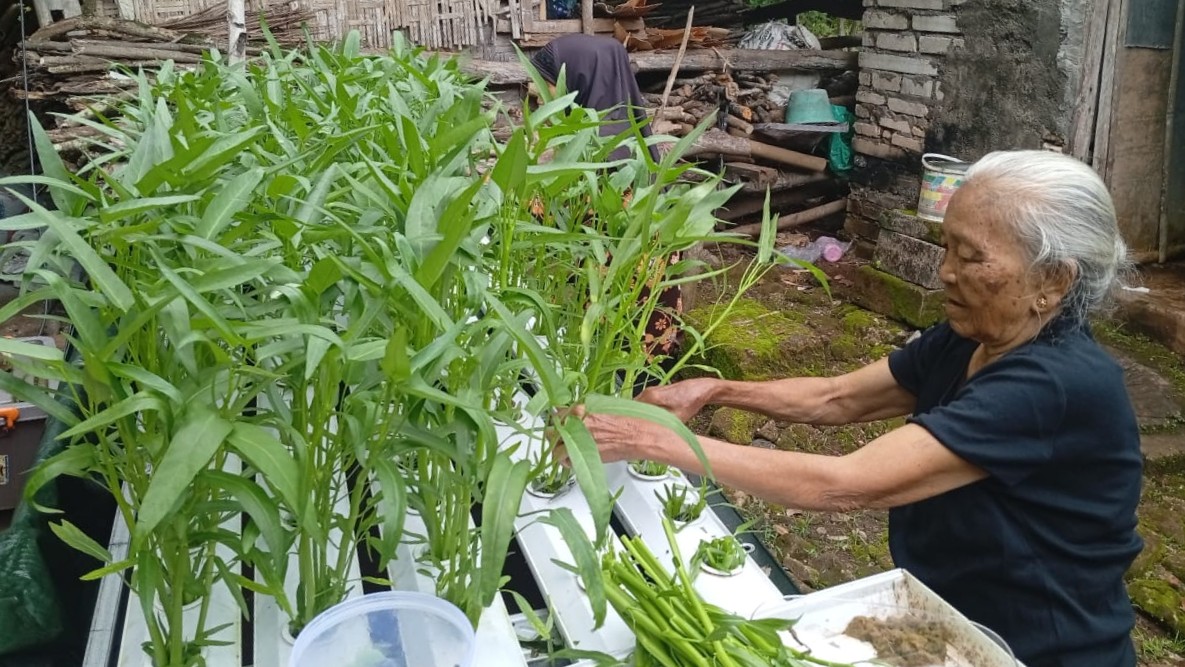
Harvesting the water spinach
What this added, almost incidentally, was the kind of weekly intergenerational contact that is becoming rare across much of Indonesia. A 73-year-old woman and younger volunteers end up sharing a bench, a conversation, and a small task every Tuesday. The food security gains followed in quiet ways. Shared maintenance lowered the load on a single household. When one of the women was unwell for a week, the system did not collapse. Because knowledge was shared, the feeding adjustments refined in week 7 were not held by any single person. They were understood by both the enumerator and the three women, so if one faltered, the others could carry it forward. Shared harvest spread the small surplus across a wider circle of neighbours, which in turn made the system feel like something the village had a stake in, not something three women were doing on their own.
We did not design the intergenerational mixing as its own intervention. Yet it ended up being one of the most meaningful outcomes of the design. The lesson, looking back, is this: when an aquaponic system is built for a single household, it stays in that household. When it is built by a bigger group, and tended by a mix of people that crosses generations – because the work requires something each generation has – it becomes something the whole community can sustain and take ownership of.
Designing this experiment, reminded us that appropriate support is participatory. It could be very different from one place to another. In this experiment, we tried to involve the elders in every step by co-designing from the start. Findings such as the inability to operate the pump were treated as data, not problems, and that task was instead redistributed to a younger volunteer. The feeding chart we built with the trainer was revised when the fish growth told a different story; we let the field set the pace. None of this is dramatic. None of it requires a flagship innovation. What it does require is the willingness to design alongside the people who will use the thing, and to keep adjusting after installation.
This is the part that the experiment could not measure. When Kopernik set out to test whether an inclusive aquaponic system could improve food security for elders in rural Gunungkidul, the hypothesis was about access to protein and vegetables. Five months later, the most meaningful discovery was the data we had set out to measure. Food security for older people in places like Teguhan is not a problem of calories. It is a question of whether the community around them is still alive, and whether they are still inside it, giving as well as receiving.
This is not a story Kopernik invented. We simply joined one already in motion. As we commemorate National Elderly Day, it seems worth noticing that humans need community across generations, no matter how old they are. The places that still understand this are teaching us a version of dignity in later life that no policy framework has been able to manufacture.
We are grateful to the Packard Foundation, ERAT Yogyakarta, and Bina Keluarga Lansia Desa Teguhan for the immense support during this pilot testing of an accessible aquaponic system for the elderly community.
